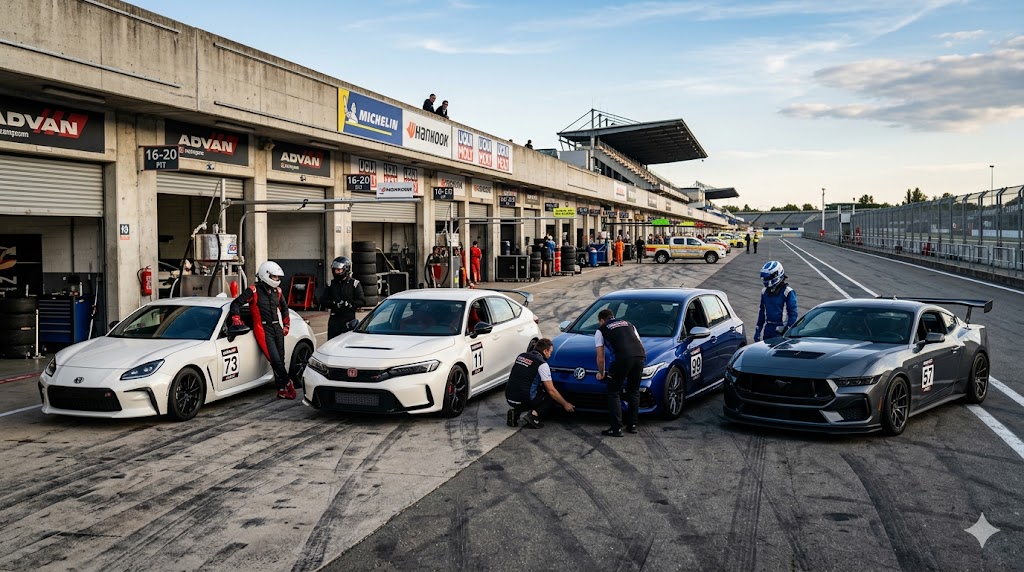
Pull into the paddock at almost any club track day in the country and you'll see the pattern repeat itself: a row of six-figure sports cars parked next to a Championship White (or increasingly, some other color) Civic Type R, and by the end of the day, the Type R owner is often posting lap times that embarrass cars costing two or three times as much. That's not an accident or a fluke of one particularly talented driver. It's the direct result of Honda building a front-wheel-drive hatchback around the specific, unglamorous priorities that club racing actually rewards—consistency, tire management, driver feedback, and a chassis that doesn't punish you for a slightly late brake point. At a rough price point around $45,000, the Type R has become something close to a default recommendation for drivers who want serious track capability without a serious car payment.
Why Front-Wheel-Drive Stopped Being a Handicap
For years, front-wheel-drive was treated as a compromise you tolerated for practicality, never something you'd choose for genuine track performance. The Type R has quietly dismantled that assumption. Honda's engineering focus on this platform centers on minimizing the traditional front-drive weaknesses—torque steer, understeer under power, and a nervous front end under trail braking—through a dual-axis strut front suspension design and careful chassis tuning rather than simply throwing more power at the problem. The result on track is a car that rotates predictably, puts power down out of corners with far less drama than older front-drive performance cars, and lets a driver of moderate skill carry real confidence into corner entry. Rear-wheel-drive and all-wheel-drive cars still hold theoretical advantages in specific scenarios, but in the tight, technical sections that make up most American club circuits, the Type R's front-drive setup stops being a limitation and starts being simply a different, well-sorted way of doing things.
The Case for Consistency Over Outright Pace
Club racing, unlike a single hot lap on a manufacturer's test track, rewards a car that can run session after session without drama. This is where the Type R separates itself most clearly from pricier exotic machinery. Its cooling systems, brakes, and tires are engineered with repeated track use in mind rather than a single showcase lap, which means a Type R driver can typically run more consecutive sessions in a day without the fade, overheating, or degraded feel that starts creeping into less track-oriented performance cars after twenty or thirty aggressive minutes. Exact lap times and performance figures vary by track, tire choice, and conditions, so treat any specific number you see quoted as anecdotal rather than a fixed benchmark, but the broader pattern that shows up consistently in track-day reports and club racing communities is that the Type R holds its pace deep into a session while some far more expensive cars start losing ground as brakes and tires heat-soak.
Where the Money Actually Went
At its approximate $45,000 price point, the Type R doesn't compete on raw straight-line output with cars costing significantly more, and it shouldn't be expected to. What that money buys instead is a chassis, suspension, and brake package tuned specifically around handling precision and driver engagement rather than headline power figures. The steering is frequently singled out by reviewers and club racers as among the best available in this price range, offering the kind of direct, communicative feedback that lets a driver place the car with confidence at the limit. The manual transmission option, which Honda has maintained on this model even as competitors abandon manuals, adds another layer of driver involvement that matters enormously in a club racing context, where rev-matching, shift timing, and mechanical engagement are part of the appeal, not just a nostalgic afterthought.
The Trade-Offs Nobody Should Gloss Over
None of this means the Type R is without real compromises, and a fair track test has to address them directly. Front-wheel-drive, however well-engineered, still means a fundamentally different power delivery character than rear-wheel-drive cars, and drivers coming from RWD backgrounds sometimes need a session or two to adjust their braking and turn-in habits accordingly. The car's aggressive aerodynamic styling, while functional, draws mixed reactions, and some drivers find the factory seating position and visibility take adjustment for serious track use. Tire wear, particularly on the front axle where power, braking, and steering forces all concentrate, tends to be higher than on a comparable rear or all-wheel-drive platform, which is a real ongoing cost for anyone running frequent track days. And while the Type R punches above its price class, it's still fundamentally a modified economy-car platform underneath the special suspension and aero, which means some interior materials and refinement details reflect that heritage rather than a from-scratch performance car design.
How It Stacks Up Against the Field
The honest comparison isn't really against exotic hypercars, despite the paddock anecdotes—it's against other cars in or near its price range, like performance-oriented trims from other manufacturers' hot hatch and sport compact lineups. Against that actual competitive set, the Type R generally wins on chassis sophistication and track-focused engineering, though rivals sometimes offer advantages in areas like all-wheel-drive traction in wet conditions or outright straight-line acceleration depending on the specific model and year you're cross-shopping. Buyers should compare current published specifications and independent track tests directly rather than relying on brand reputation alone, since Honda, like every manufacturer, updates trims and specifications over model years, and what was true of an earlier Type R generation may not hold for the current one.
Who Should Actually Buy One for Track Duty
The Type R makes the most sense for drivers who want a single car that handles daily commuting duties competently during the week and serious club track days on the weekend without a trailer, a tow vehicle, or a second car payment. It's less ideal for drivers chasing outright lap records against purpose-built track cars, or for anyone who specifically wants the rear-wheel-drive drift-and-slide driving character that some club racers prefer. For the large middle of the club racing population, though, people who want genuine capability, real durability across a full track day, and a car they can drive home afterward, the value case at its roughly $45,000 price point is difficult for competitors to match.
Key Takeaways
- The Civic Type R's dual-axis front suspension largely neutralizes the traditional weaknesses of front-wheel-drive performance cars on track.
- Its brakes, cooling, and tires are built for session-after-session consistency, which matters more in club racing than a single hot lap.
- At roughly $45,000, the money goes toward chassis tuning, steering feel, and a manual transmission rather than headline power numbers.
- Real trade-offs include front tire wear, an adjustment period for drivers used to rear-wheel-drive, and interior refinement tied to its economy-car roots.
- The fairest comparison is against similarly priced hot hatches and sport compacts, not exotic machinery, even though it often outpaces pricier cars at track days.
- Bottom line: for club racers who want one car for both commuting and serious weekend track duty, the Type R remains one of the strongest value propositions in its class.