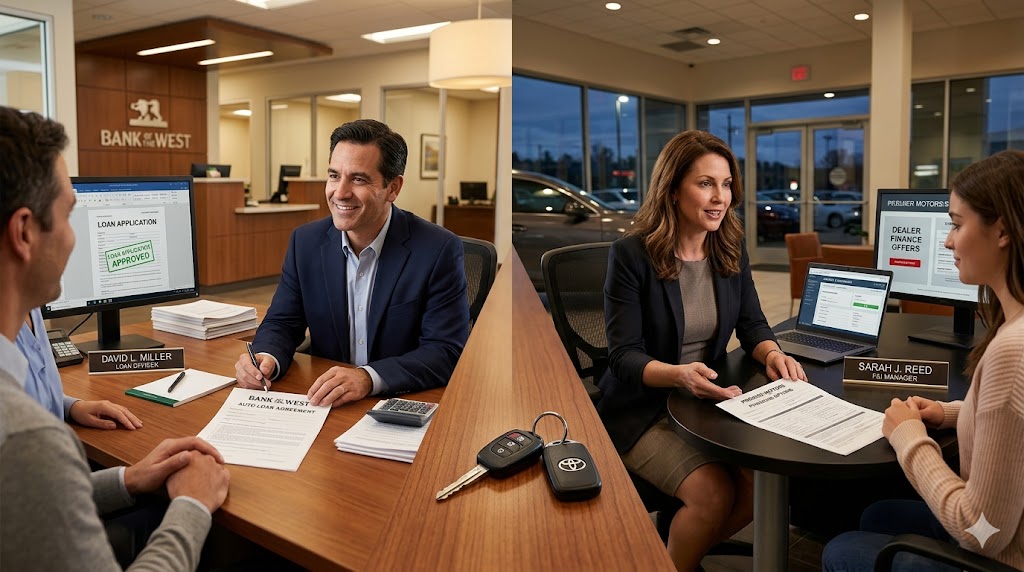

The finance manager slides the contract across the desk with a rate that feels almost too easy to accept, and that's precisely the moment most car buyers overpay without realizing it. Not because the dealer lied to them, but because nobody in the room mentioned that the number on that page usually includes a markup layered on top of what the actual lender approved. Meanwhile, a credit union three miles away might have quoted a lower rate on the exact same loan amount, for the exact same borrower, with no theatrics involved. The question of which financing source saves you the most money isn't theoretical — it's a real gap that shows up in your monthly payment for the next five or six years, and the answer depends on understanding how each channel actually makes its money.
How Dealer Financing Really Prices Your Loan
When you finance through a dealership, you're rarely borrowing directly from the dealer. Instead, the finance office shops your application to a handful of banks, credit unions, and captive lenders (like the manufacturer's own finance arm), then picks an offer. Here's the part that catches buyers off guard: dealers are typically allowed to add a markup on top of the rate the lender approved, a practice often called dealer reserve or dealer participation. The lender might approve you at one rate, and the dealer presents you with a higher one, pocketing the difference as compensation for originating the loan. This isn't illegal or even hidden — it's disclosed in the financing paperwork — but it's rarely explained in plain language at the point of sale.
That markup is exactly why dealer financing can be either the cheapest or the most expensive option in the room, depending entirely on your credit profile and how hard you push back. If you have strong credit and you negotiate the rate the way you'd negotiate the vehicle price, dealers can and do come down, especially when a manufacturer is running a subsidized promotional rate to move inventory. Those manufacturer-subsidized rates, when they exist, are genuinely hard to beat because the automaker is absorbing part of the financing cost to sell cars — no outside bank or credit union can match a rate that's being artificially subsidized from the top. But when no special offer applies, the quoted rate is just a market-rate loan with a markup baked in, and plenty of buyers who never comparison-shop end up paying that markup without knowing an alternative existed.
Where Credit Unions Tend to Have an Edge
Credit unions operate as member-owned, not-for-profit institutions, which changes their incentive structure in a way that often benefits borrowers. Because they don't answer to shareholders demanding quarterly returns, credit unions frequently run leaner overhead and can pass savings through as lower loan rates or reduced fees rather than maximizing margin on every transaction. This is a structural difference, not a marketing claim, and it's the reason credit unions consistently show up well in independent rate surveys and comparison data on auto loans.
The trade-off is access and speed. You typically have to qualify for membership — based on where you live, work, worship, or through an affiliated association — and that membership requirement, along with sometimes opening a small share account, adds a step that a dealer's one-stop financing doesn't require. Credit unions can also be slower to close than a dealership that has the paperwork machine running in-house, and their underwriting can be more relationship-based, meaning a thin credit file or a first-time buyer without an existing history at that institution may not get the best rate on the shelf. Still, if you already belong to a credit union or can join one easily, getting a pre-approval before you ever set foot on a lot gives you a real, bankable number to compare against whatever the dealer's finance office produces — and that number often has less markup baked into it because you cut out the origination middleman.
What Banks Bring to the Table
Banks compete on a different axis entirely: relationship banking. If you hold a checking account, savings account, mortgage, or investment relationship with a particular bank, that institution often has an incentive to offer you a preferential auto loan rate or fee discount to keep your business bundled under one roof. This is a legitimate lever worth pulling, particularly with large national banks and regional banks that explicitly advertise loyalty or relationship discounts for existing customers financing a vehicle.
Banks also tend to have more standardized, algorithm-driven underwriting than either dealers or credit unions, which can work in your favor if you have strong, well-documented credit, since the process is often fast and transparent. The downside is that banks aren't always competitive for buyers with average or below-average credit, where their rate cards can be less forgiving than what a credit union or a subsidized manufacturer program might offer. Banks also generally don't have the same appetite as captive finance arms for stretching underwriting to hit sales targets, so if your credit file has some rough edges, a bank pre-approval might come back higher than you hoped, or not at all.
The Real Comparison Happens Before You Walk In
The single biggest lever you control in this entire decision is timing: get pre-approved by at least one bank and one credit union before you ever discuss financing with a dealer. A pre-approval isn't a formality — it's a real, underwritten offer with an actual rate attached, and it does two things simultaneously. First, it gives you a firm number to walk away with if the dealer's financing doesn't beat it. Second, and more importantly, it puts you in a position to let the dealer compete against your outside offer rather than negotiating in a vacuum where you have no idea whether the number in front of you is good, mediocre, or padded with markup.
Dealers can and often will beat an outside pre-approval, particularly when they're motivated to close the sale or when a manufacturer incentive is in play, because matching or beating your rate costs them less than losing the deal. But they can only do that if you give them something to beat. Walking in without a pre-approval means the finance office has no external benchmark forcing their hand, and you're relying entirely on your own negotiating skill and awareness of dealer reserve practices to avoid overpaying.
Reading the Fine Print Behind the Rate
The rate itself is only part of the picture — loan term length, prepayment penalties (rare on auto loans but worth confirming), gap insurance bundling, and add-on products sold in the finance office all affect the true cost of the loan. A dealer might offer a rate that looks competitive on paper while extending the term to lower the monthly payment, which increases total interest paid over the life of the loan even if the rate itself is reasonable. Credit unions and banks are more likely to present term options plainly without the pressure to bundle extras, simply because their business model doesn't depend on finance-office product sales the way a dealership's often does. Comparing loans strictly by monthly payment, without looking at term length and total interest, is one of the most common ways buyers convince themselves they got a good deal when they didn't.
Comparing Actual Offers Is the Only Way to Know
No blanket rule says dealers, banks, or credit unions will always be cheapest, because rates shift with the broader interest rate environment, your individual credit profile, regional competition, and whatever manufacturer incentives happen to be running the month you buy. The only reliable method is to gather real, current offers from all three channels and put them side by side using the same loan amount and term, then check your numbers against a current published auto loan rate survey to see where each offer falls relative to the broader market. This is general information for educational purposes only, not financial or legal advice, and you should evaluate your own credit situation and consult a qualified financial professional before committing to a loan.
Key Takeaways
- Dealer financing marks up an approved lender rate through dealer reserve, so the quoted number often has room to negotiate down.
- Manufacturer-subsidized promotional rates, when available, are usually the hardest offer for banks or credit unions to beat.
- Credit unions frequently offer lower rates due to member-owned, not-for-profit overhead, but require membership and can close more slowly.
- Banks compete well through relationship discounts for existing customers but can be less flexible for buyers with weaker credit.
- Getting pre-approved by a bank or credit union before visiting the dealer gives you real leverage to make the finance office compete.
- Bottom line: no single source wins by default — compare actual, current offers side by side, and let outside pre-approval pressure the dealer's number down.