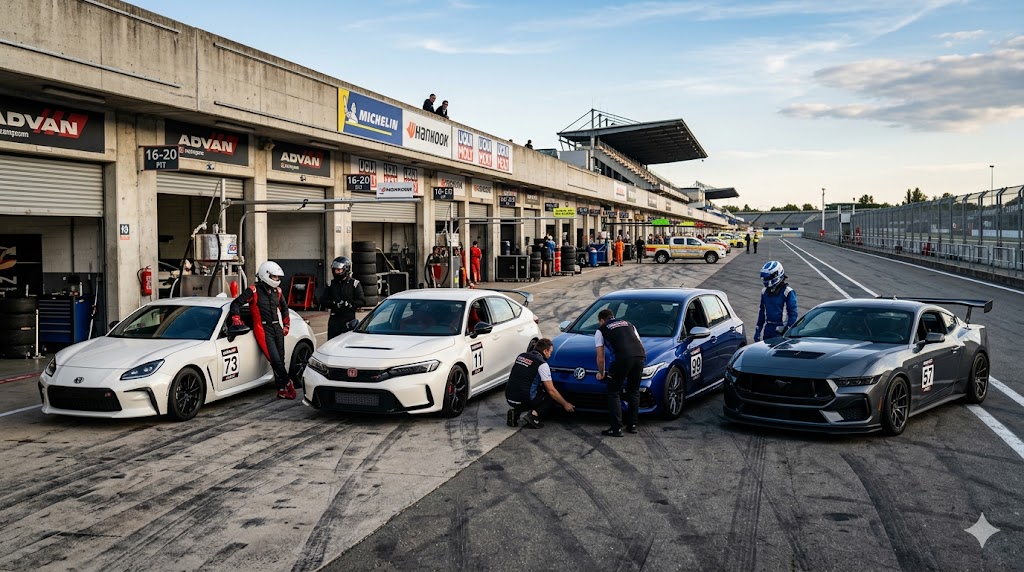
The moment that convinces most drivers they need a big brake kit isn't a spec sheet comparison, it's a specific, uncomfortable sensation: the pedal going long and soft on the third hard stop of a spirited drive or track session, when the first two stops felt completely normal. That's brake fade, and it's the actual problem a big brake kit exists to solve. Understanding what's happening in that moment, rather than just chasing bigger rotors because they look aggressive, is what separates a brake upgrade that solves a real problem from one that's mostly cosmetic.
What's Actually Failing When Brakes Fade
Braking converts your car's kinetic energy into heat through friction between the pads and rotors, and that heat has to go somewhere. Factory brake systems are engineered by manufacturers to handle a specific, realistic range of use, everyday driving plus a reasonable margin for occasional hard stops, but they're rarely designed with sustained track use in mind, because that's not what the overwhelming majority of buyers do with the car. When you brake hard repeatedly in a short span, at a track day, descending a mountain pass, or during aggressive backroad driving, the rotors and pads accumulate heat faster than the factory system can dissipate it, and once the pads exceed their designed temperature range, the friction material itself starts to break down chemically, releasing gases that create a thin film between pad and rotor and dramatically reducing the friction available. The result is the long, soft pedal and the unnerving realization that the car isn't stopping the way it did five minutes earlier.
This is a genuinely different problem from simply wanting shorter stopping distances from a single hard stop, which factory brakes on most performance-oriented cars already handle reasonably well when both pads and rotors are cold and in good condition. A big brake kit's real value proposition is sustained performance under repeated hard use, not necessarily a dramatically shorter panic-stop distance from a single cold application.
What a Big Brake Kit Changes
A genuine big brake kit typically increases rotor diameter and thickness, which adds thermal mass, more material to absorb heat before reaching a critical temperature, and often increases the effective radius at which the caliper clamps the rotor, which improves leverage on the wheel. It also usually replaces the caliper with a unit that has more pistons and a stiffer body, improving pad clamping force and reducing caliper flex under hard use, which keeps pedal feel firmer and more consistent as heat builds. Larger rotors also generally have more surface area exposed to airflow, which helps dissipate heat faster during the recovery period between hard stops.
The combined effect, more thermal capacity, better heat dissipation, and stiffer, more consistent clamping, is what actually prevents the fade scenario described above. It's not that the bigger rotor alone stops the car faster in a single isolated stop, it's that the whole system resists the cumulative heat buildup that causes fade during repeated hard use, which is precisely the scenario where factory brakes on non-performance-oriented trims most often come up short.
The Pad and Fluid Half of the Equation
It's worth being honest that a big brake kit is only part of the fade-resistance equation, and a surprising number of drivers spend significant money on bigger hardware while ignoring the two cheaper components that often matter just as much: brake pad compound and brake fluid. Factory pads on most cars are formulated to work well cold and to minimize noise and dust for daily driving, priorities that trade away high-temperature performance. A track-oriented or high-performance street pad compound, on rotors that haven't changed at all, can meaningfully raise the temperature threshold before fade sets in. Brake fluid matters just as much because fluid absorbs moisture over time, and moisture lowers its boiling point; if the fluid boils under heavy braking heat, it introduces compressible gas bubbles into the lines and the pedal goes soft or all the way to the floor regardless of how big your rotors are. Fresh, high-quality fluid with a higher boiling point, changed on a reasonable schedule, is one of the least expensive and most impactful things a spirited driver can do, and it's often overlooked entirely by buyers focused on visible hardware.
Do You Actually Need One
For a driver who occasionally does a track day or an aggressive mountain drive but mostly commutes normally, upgrading pad compound and fluid first, and evaluating whether fade is still a problem, is the financially sensible sequence before committing to a full big brake kit. Many drivers find that better pads and fresh fluid alone solve the fade they were experiencing, particularly if the factory rotors and calipers were otherwise in good condition. For a driver doing regular track days, autocross with repeated runs, or living somewhere with long descending grades that demand sustained hard braking, the added thermal capacity of a genuine big brake kit becomes a much easier case to justify, because the frequency and severity of heat buildup routinely exceeds what pad and fluid changes alone can manage.
The Trade-Offs That Come With Bigger Brakes
Bigger brakes aren't free of downsides. They add unsprung rotating weight at exactly the corner of the car where that weight matters most for ride and handling, which can partially offset gains made elsewhere, like lighter wheels. They also require wheels with enough internal clearance to clear the larger caliper, which sometimes rules out a wheel design you otherwise wanted, or forces a size change you hadn't planned on. And a kit sized well beyond what your driving actually demands doesn't just fail to help, it can make the pedal feel overly grabby or numb at normal street speeds, since it's designed around a heat range you're rarely generating in daily use. Buying the largest kit available for bragging rights, rather than the kit sized appropriately to your actual use case, is a common and expensive mistake.
Key Takeaways
- Brake fade happens when repeated hard stops overheat the pads and rotors faster than they can dissipate heat, not from a single hard stop.
- A big brake kit's main benefit is sustained stopping performance under repeated hard use, not dramatically shorter single-stop distances.
- Larger rotors add thermal mass and surface area, while upgraded calipers improve clamping consistency as heat builds.
- Upgrading pad compound and brake fluid first is often the cheaper, equally effective fix for occasional spirited driving.
- Bigger brakes add unsprung weight and require wheel clearance, and an oversized kit can hurt everyday pedal feel.
- Match the kit to your actual driving: regular track or mountain driving justifies a big brake kit, while occasional spirited driving often doesn't need one.